The anxiety-accounting gapWhy the whole category keeps failing the same people
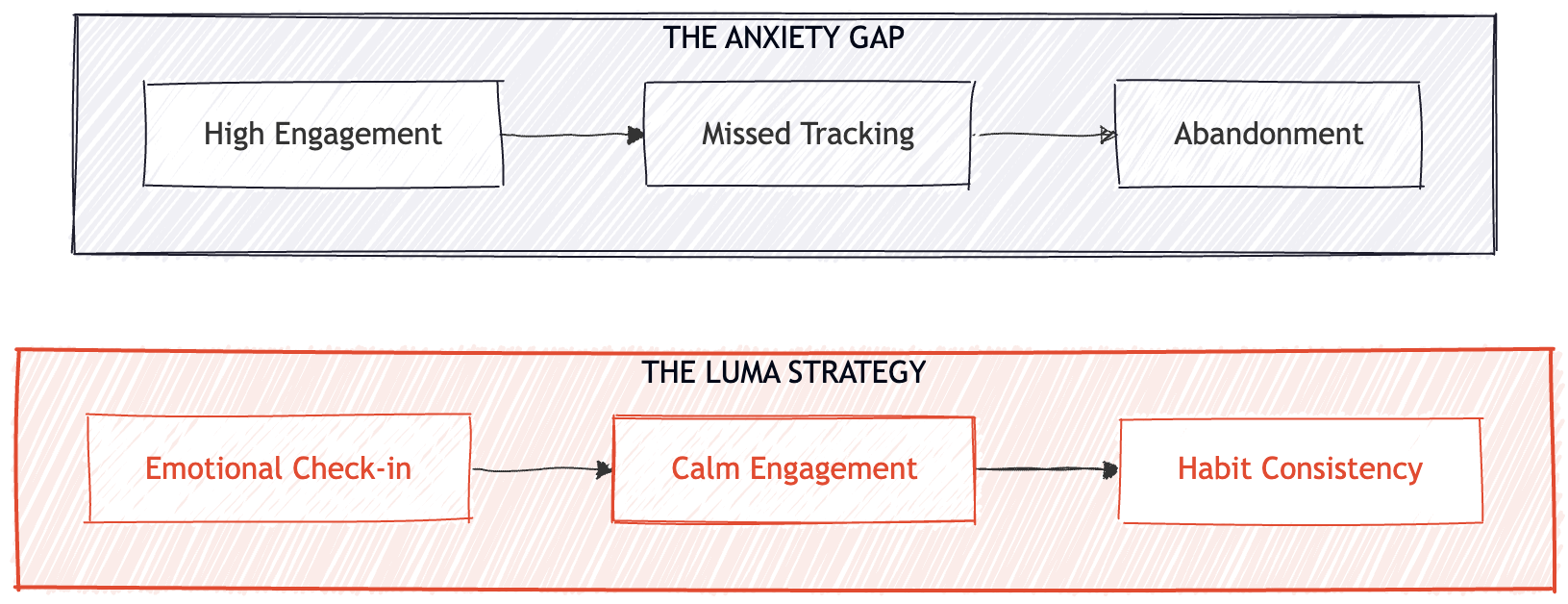
Most finance apps treat money as a maths problem. Track every transaction, categorise every purchase, surface a dashboard full of numbers. The logic is sound and the assumption is wrong. Users with money anxiety don't fail because they lack data. They fail because the apps make them feel judged.
Luma starts from a different premise: money problems are behavioural, not mathematical. Fix the emotional relationship with money first and the financial outcomes follow.
So the objective was a habit-first financial coach that prioritises emotional awareness and consistency over perfect ledger reconciliation. Not tracking every cent. Building a healthier relationship with money over time.
Surveillance to supportA saturated market, saturated in one direction
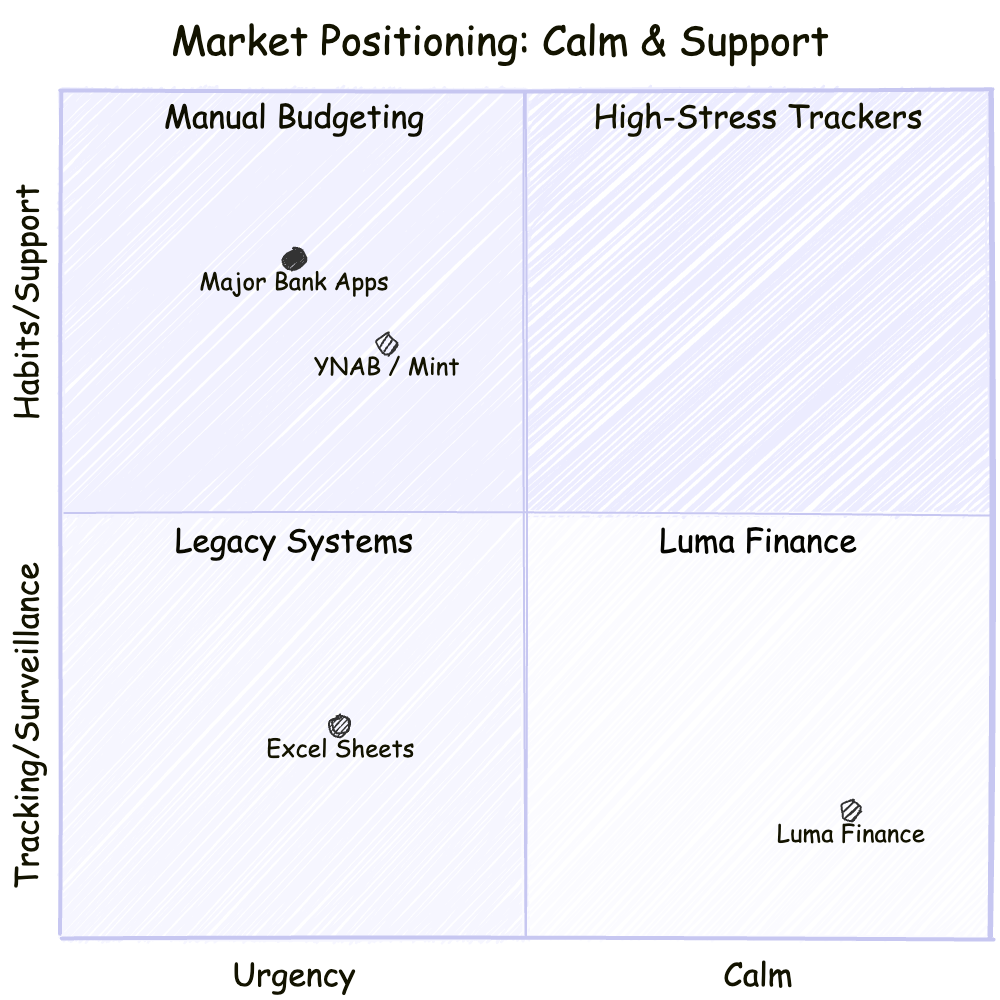
The personal finance market is crowded, but it is crowded in a single direction. Every major player frames money management as a performance metric. Green means winning, red means failing. The entire category is built on urgency and accountability.
That leaves an obvious white space: a product that leads with support rather than surveillance.
Money problems are behavioural, not mathematical.
The persona is the independent earner: 25 to 40, has tried budgeting apps and quit, earns enough but feels anxious about money. Optimised for reflection over reaction, and consistency over perfection.
Accuracy, completeness, category tracking, performance dashboards.
Emotional awareness, habit consistency, calm engagement, long-term retention.
Check in, reflect, adjustEngagement without a stress response
The central design problem: how do you keep someone engaged with their finances without triggering the exact anxiety that made them quit last time? The answer was to change the entry point.
Unlike every other app, the first thing you see is not a transaction list. It is an emotional check-in: "How did today feel financially?" That reframes the product from auditor to coach. The loop takes under two minutes and reads like journalling, not accounting.
The product is explicitly designed for imperfection. Missing a day resets gently rather than punitively. Partial tracking is supported by default. The all-or-nothing barrier that kills engagement in traditional apps is removed by design, not by tone of voice.

Shared intent, not shared controlSocial motivation without surveillance
Shared finances are a minefield. Couples and accountability partners sharing financial data usually manufacture pressure and judgment, which is the opposite of what Luma is for. The problem was solving for social motivation without building a surveillance tool.
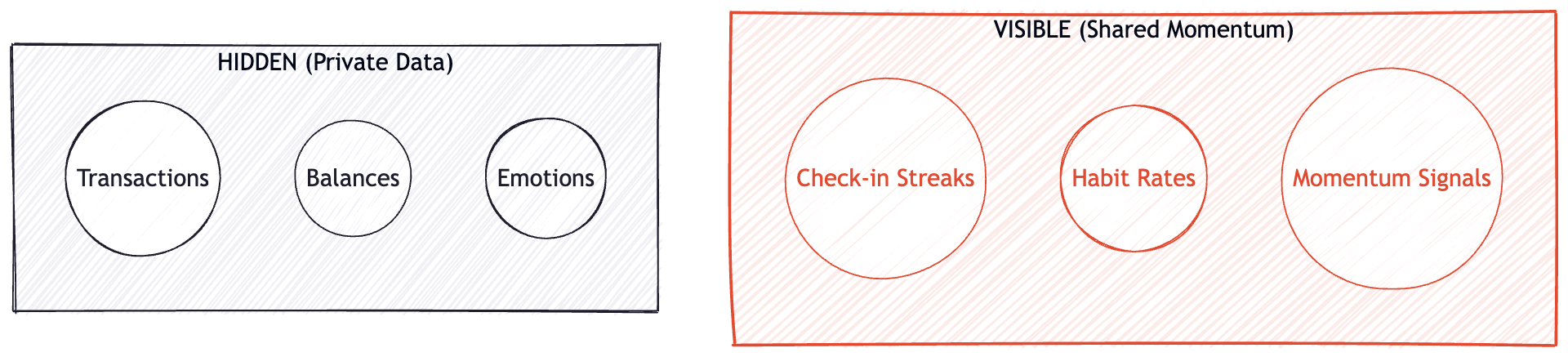
The privacy logic is built so that even a curious or controlling partner cannot extract meaningful financial data. What they get is aggregate signal: momentum, not money.
Weekly check-in streaks. Habit completion rates. General momentum signals.
Transactions, balances, emotional responses, individual habit detail.
Defined by what was cutThe hardest PM skill is knowing what not to build
The temptation with a finance app is to integrate with banks immediately. It feels like the real version of the product, and it is the first thing every early user asks for. But bank integrations in V1 would have shifted the centre of gravity from habit-building to transaction-tracking, which is precisely the pattern Luma exists to break.
So they are deferred to V2 deliberately. Not because there wasn't time. Because shipping them first would have made a different product.